admin
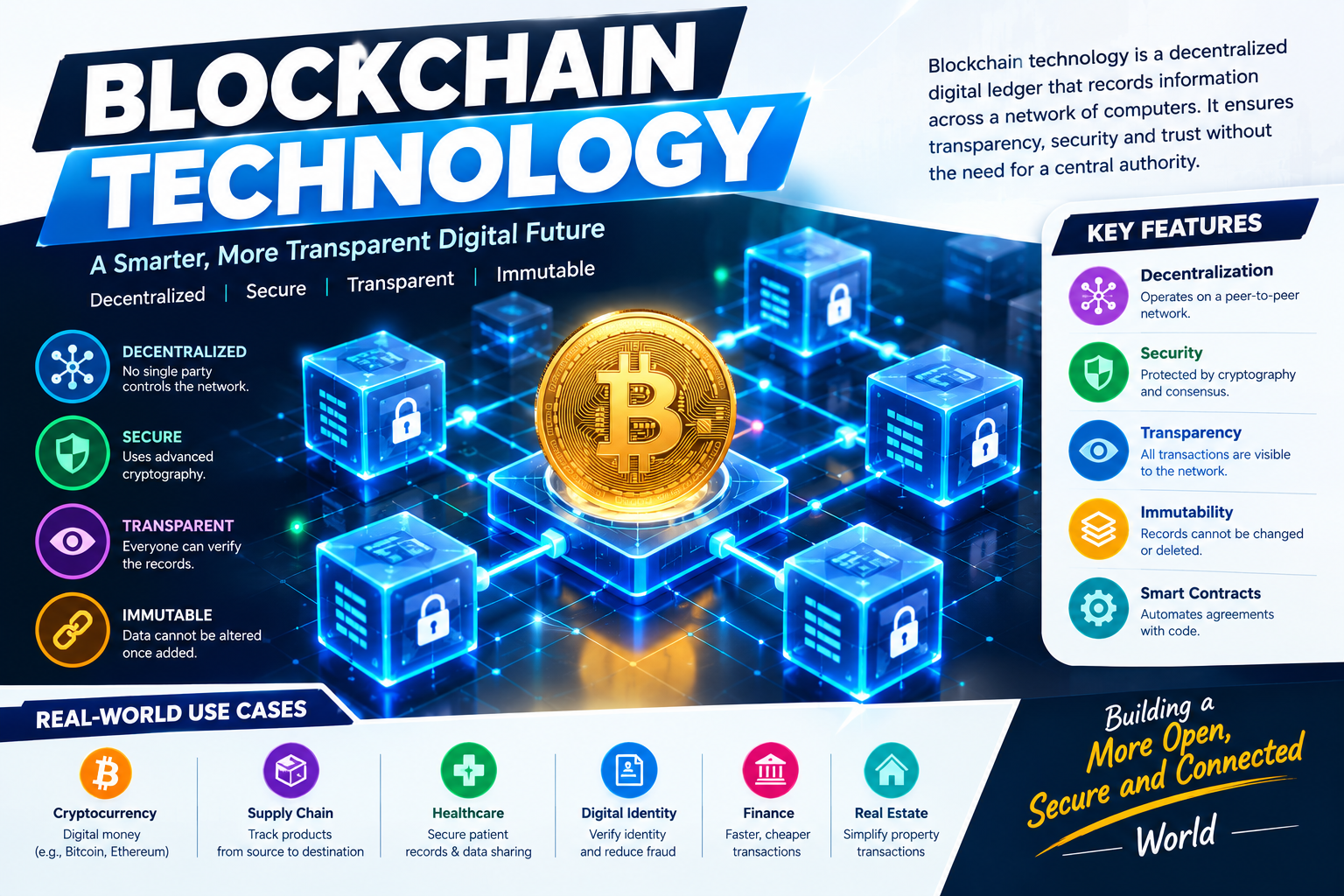
Introduction to Blockchain Technology
Blockchain technology is changing how people store information, transfer digital Blockchain Technology assets, and conduct transactions online. Originally developed as the underlying technology for Bitcoin, blockchain has expanded into finance, healthcare, supply chain management, digital identity, and many other industries. Its ability to maintain records across a distributed network makes it an important innovation in the modern digital economy.
Unlike traditional databases controlled by a single organization, blockchain technology can allow multiple participants to share and verify records without relying entirely on one central authority. Transactions are grouped into blocks, and these blocks are connected using cryptographic techniques to create a chronological record. Depending on the blockchain design, participants may use consensus mechanisms to agree on which transactions should be accepted.
In 2026, blockchain technology remains an important area of development for businesses, developers, financial institutions, and cryptocurrency users. However, understanding its real capabilities requires looking beyond the hype. Blockchain systems can improve transparency and coordination, but they also face challenges involving scalability, privacy, regulation, energy use, and security.
This guide explains blockchain technology, how it works, its main types, practical applications, benefits, limitations, and future possibilities.
What Is Blockchain Technology?
Blockchain technology is a method of recording and sharing digital information across a network of computers. Instead of keeping all records in one central database, many blockchain systems distribute copies of the ledger among participating computers called nodes.
Each block generally contains a group of transactions or records, a timestamp or other ordering information, and a cryptographic reference to the previous block. This reference helps connect blocks into a chain. If someone changes information in an earlier block, the change can affect its cryptographic links and be detected by other participants.
A blockchain is not automatically anonymous, completely private, or impossible to modify. Its security depends on the network design, consensus mechanism, cryptographic implementation, and incentives that encourage participants to follow the rules.
Public blockchains such as Bitcoin allow broad participation, while private and permissioned systems restrict who can read records, submit transactions, or validate activity. These differences make blockchain suitable for several types of use cases, although a conventional database may be more practical for some applications.
How Does Blockchain Technology Work?
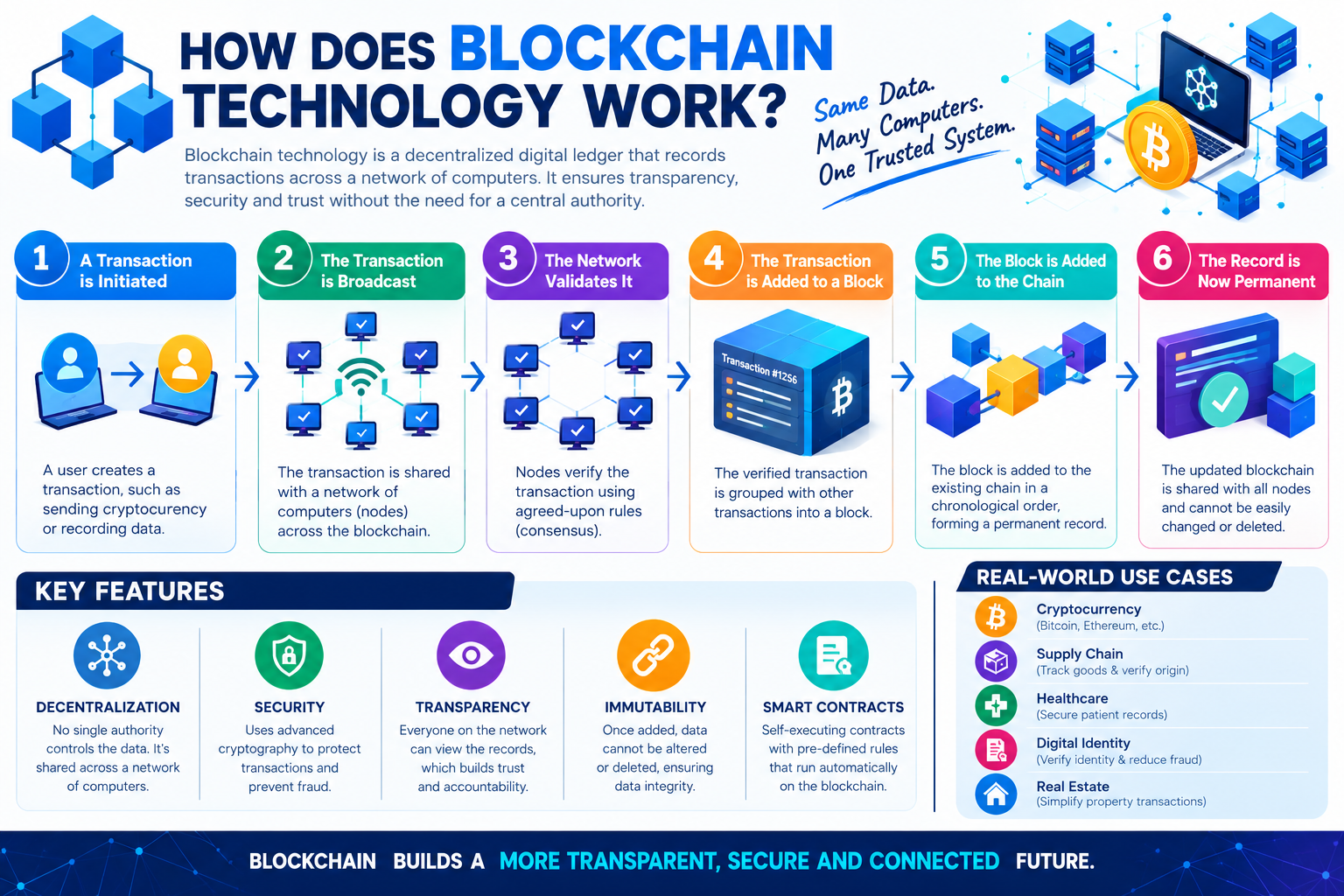
Understanding how blockchain technology works helps explain why it is used for cryptocurrencies and other digital systems. Although different networks have different rules, many blockchain processes share several basic steps.
Transactions Are Created
The process usually begins when a user initiates a transaction. In a cryptocurrency network, this could mean sending digital coins to another wallet. In another system, it might involve registering a product movement, issuing a digital certificate, or recording a business event.
The transaction is submitted to the network for verification. Depending on the blockchain, it may include a digital signature that helps prove the sender has authorized the action.
Network Nodes Verify Transactions
Participating computers, known as nodes, check whether transactions follow the network’s rules. A cryptocurrency node may verify digital signatures, confirm that the sender has sufficient funds, and reject transactions that attempt to spend the same funds twice.
Not every blockchain uses the same verification process. Some rely on public validators, while others permit only approved organizations to validate transactions.
Valid Transactions Are Grouped Into Blocks
After verification, eligible transactions can be collected into a proposed block. The block’s contents depend on the network’s rules and may include transaction data, ordering information, and a cryptographic reference to an earlier block.
This structure helps maintain a consistent history of activity.
Consensus Adds Blocks to the Chain
Blockchain networks need a way to agree on which blocks should become part of the accepted ledger. This process is called consensus.
Bitcoin uses Proof of Work, in which miners compete to produce valid blocks by performing computational work. Many other networks use Proof of Stake, where validators participate according to protocol rules involving staked assets and other requirements.
Consensus mechanisms differ in security assumptions, performance, energy requirements, and governance. No single mechanism is ideal for every situation.
The Ledger Is Updated
Once a block is accepted according to the network’s rules, participating nodes update their records. The new block becomes part of the blockchain’s transaction history.
On many public networks, changing older records becomes increasingly difficult as additional blocks are added. Nevertheless, blockchain immutability is a practical security property rather than an absolute guarantee. Network attacks, software bugs, governance decisions, or protocol changes can affect how records are treated.
Main Types of Blockchain Technology
Blockchain systems can be classified by who may access the network and who is allowed to validate transactions.
Public Blockchain
A public blockchain is generally open for anyone to inspect, and participation rules are available publicly. Bitcoin and Ethereum are well-known examples, although their technical designs and functions differ.
Public networks can support open participation, independent verification, and applications that do not depend on a single operator. Their limitations may include transaction fees, variable processing speeds, public visibility of transaction data, and the need for strong network-wide security.
Private Blockchain
A private blockchain restricts participation to approved users or organizations. A company might use one to share records among departments or selected business partners.
Private systems can offer greater control over access and transaction processing. However, they may provide fewer decentralization benefits because a limited group of operators controls important network functions.
Consortium Blockchain
A consortium blockchain is managed by a group of organizations rather than one company or the general public. For example, several financial institutions or supply chain partners might jointly maintain a shared ledger.
This approach can distribute responsibility among participating organizations while keeping access controlled. Its success depends on governance agreements, technical compatibility, and trust among members.
Hybrid Blockchain
A hybrid blockchain combines selected public and private features. An organization might keep sensitive business information restricted while publishing proofs or selected records to a public network.
This design can balance confidentiality with independent verification, but it requires careful planning about which data is shared and how permissions are enforced.
Key Features of Blockchain Technology
Several characteristics explain why blockchain technology attracts attention across industries.
Decentralization
In decentralized networks, control and recordkeeping are distributed among multiple participants instead of being concentrated entirely in one central operator. This can reduce dependence on a single organization.
However, decentralization varies. A network may have many nodes but still depend heavily on a small number of validators, developers, infrastructure providers, or governance participants.
Transparency and Traceability
Some blockchains allow the public to inspect transactions and follow activity over time. This can make it easier to verify records and trace the movement of digital assets.
Transparency does not mean that every user’s real-world identity is visible. Public addresses may be pseudonymous, but transaction patterns can sometimes be linked to individuals or organizations through additional information.
Cryptographic Security
Blockchain systems use cryptographic techniques to protect transaction authorization and connect records. Digital signatures help establish that an authorized key approved a transaction, while cryptographic hashes help reveal changes to stored data.
These tools do not eliminate every security risk. Wallet theft, compromised private keys, vulnerable applications, malicious smart contracts, and exchange failures can still cause losses.
Shared Records
A distributed ledger can provide participants with a common record of events. This can reduce disagreements caused by inconsistent databases and repeated reconciliation between organizations.
The benefits are strongest when multiple independent parties need to coordinate and no single participant should have unilateral control over the shared record.
Real-World Applications of Blockchain Technology
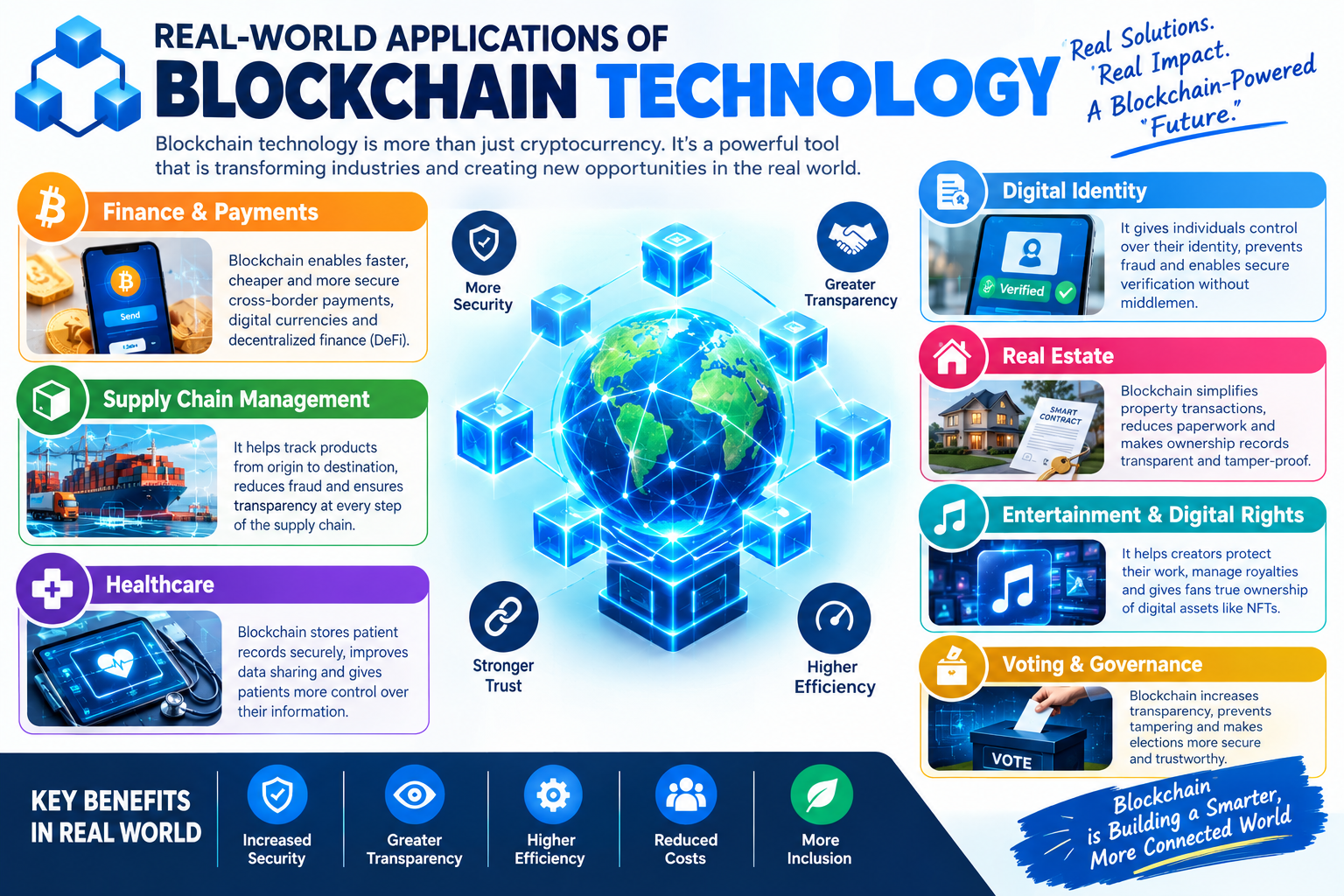
Blockchain has applications beyond buying and selling cryptocurrency. Whether it is useful depends on the problem being solved and the reliability of the information entered into the system.
Cryptocurrency and Digital Payments
Cryptocurrencies are among the best-known uses of blockchain. Bitcoin records transactions involving BTC, while other networks support different digital assets and programmable applications.
Depending on the network and service, blockchain-based payments may enable cross-border transfers without relying on every traditional intermediary. Users must still consider network fees, confirmation times, exchange rates, wallet security, and local legal requirements.
Smart Contracts and Decentralized Finance
A smart contract is software deployed on a blockchain that executes according to programmed rules. Smart contracts can support token exchanges, lending protocols, digital marketplaces, and other applications.
Decentralized finance (DeFi) uses blockchain-based systems to offer financial services through smart contracts. These services can expand access to programmable financial tools, but they may involve code vulnerabilities, liquidity problems, oracle manipulation, and significant market risk.
Supply Chain Management
Businesses can use blockchain to record product movements, certifications, and handoffs between organizations. A shared ledger may help participants investigate delays, verify documentation, and identify inconsistencies.
However, blockchain cannot independently confirm whether a physical product is genuine or whether information entered by a supplier is accurate. Reliable sensors, inspections, audits, and data-entry controls remain important.
Healthcare and Medical Records
Healthcare organizations may explore blockchain for verifying data access, coordinating records, or tracking medical supplies. A properly designed system could help authorized participants confirm that certain events occurred.
Sensitive patient information should not automatically be placed on a public blockchain. Privacy laws, consent, access controls, and the difficulty of removing permanent records must be considered. In many cases, storing encrypted or personal data off-chain while recording limited proofs on-chain is more appropriate.
Digital Identity and Certificates
Blockchain can support systems for verifying credentials, certificates, and selected identity claims. A person might use a digitally signed credential to prove a qualification without sharing every detail of their identity.
These systems still need trusted issuers, secure recovery processes, and protections against stolen credentials. A blockchain record alone does not establish that an identity claim is truthful.
Tokenization of Real-World Assets
Tokenization represents rights to an asset through digital tokens. Depending on the legal structure, tokenized assets might represent interests in funds, property, commodities, or other financial instruments.
Tokenization can make certain transfers and recordkeeping processes more programmable. It does not automatically grant legal ownership, guarantee liquidity, or remove the need for regulated custodians and enforceable agreements.
Benefits of Blockchain Technology
Blockchain can offer meaningful advantages when its design fits the needs of a particular application.
One major benefit is shared verification. Multiple parties can check records against common network rules rather than depending entirely on one organization’s database. This can reduce certain reconciliation tasks and help participants audit transactions.
Another advantage is tamper evidence. Cryptographic links and distributed consensus can make unauthorized changes easier to detect and, on appropriately secured networks, harder to carry out successfully.
Blockchain can also support programmable transactions through smart contracts. Developers can encode rules for payments, token transfers, and business processes, reducing the need for some manual steps. Such automation must be carefully tested because bugs can produce unexpected outcomes.
For international businesses, a shared ledger may improve coordination across organizations operating different systems. Public networks may also allow developers to build applications on open infrastructure without negotiating access with a single database owner.
Nevertheless, these benefits are not guaranteed. They depend on governance, implementation quality, user experience, and whether blockchain is actually better suited to the task than conventional technology.
Challenges and Limitations of Blockchain Technology
Despite its potential, blockchain technology has important limitations.
Scalability and Transaction Speed
Some blockchain networks process fewer transactions per second than centralized payment systems. During busy periods, users may face higher fees or slower confirmation times.
Layer-2 networks, improved consensus mechanisms, and other scaling methods aim to increase capacity. However, these approaches introduce different trade-offs involving security, data availability, liquidity, and system complexity.
Energy Consumption
Proof of Work networks require computational resources to secure the ledger. Their energy use depends on network economics, mining equipment, and the electricity sources used.
Proof of Stake generally avoids the same competitive mining process and usually requires substantially less energy. Energy impact should therefore be evaluated by looking at the specific blockchain rather than treating all blockchain systems as equally resource-intensive.
Privacy Concerns
Public blockchains can permanently expose transaction details, wallet balances, and interaction histories. Even when names are not shown directly, patterns can sometimes reveal information about users.
Privacy-preserving technologies and off-chain storage can help, but they require careful implementation and may have regulatory implications.
Regulation and Legal Uncertainty
Blockchain businesses may need to follow rules involving financial services, consumer protection, taxation, data privacy, securities, and anti-money-laundering controls. Requirements vary by jurisdiction and type of activity.
Organizations should obtain appropriate legal and compliance advice before launching blockchain-based financial products or collecting personal information.
Security Risks
The blockchain protocol is only one part of the security picture. Users may lose funds through phishing, compromised devices, exposed recovery phrases, fraudulent projects, or insecure smart contracts.
Bridges between networks and poorly managed administrative keys can also become targets. Security audits, independent testing, strong key management, and careful operational procedures are essential.
Blockchain Technology vs. Traditional Databases
Traditional databases and blockchains both store information, but they solve different problems.
A traditional database is often preferable when one trusted organization controls the system, records need frequent editing or deletion, and high performance is a priority. Database administrators can define access rights, correct mistakes, and manage data efficiently.
Blockchain can be useful when several parties need to share a history of transactions and want independent verification under agreed rules. Its distributed architecture can reduce reliance on a single operator, although it may introduce extra costs and complexity.
The right choice depends on the use case. A blockchain should not be selected simply because it is a new technology. Developers should first determine whether multiple independent participants need a shared ledger and whether the benefits justify the trade-offs.
The Future of Blockchain Technology in 2026 and Beyond
The future of blockchain technology will likely depend on practical utility rather than hype. Developers and businesses continue to explore ways to make networks easier to use, more scalable, and better integrated with existing systems.
One important area is Layer-2 scaling, which aims to move some transaction activity away from a base blockchain while relying on defined security mechanisms. These systems may lower costs or improve transaction capacity, though users need to understand the security assumptions of each solution.
Another area is institutional adoption. Financial organizations are exploring tokenization, settlement systems, and blockchain-based recordkeeping. Adoption will depend on reliable infrastructure, legal clarity, interoperability, and demonstrable benefits over existing services.
Interoperability is also important because different blockchains often operate with separate rules and assets. Cross-chain tools aim to connect these environments, but bridges and messaging systems can introduce additional security risks.
Developments in digital identity, verifiable credentials, and supply chain tracking may provide value in selected contexts. Artificial intelligence and blockchain may also be combined for data provenance, audit trails, or automated transactions, although blockchain does not guarantee that AI-generated information is accurate.
The most sustainable applications will likely be those that solve specific problems, protect users, and operate transparently within applicable laws.
How to Get Started With Blockchain Technology
People interested in blockchain can begin by learning basic concepts such as wallets, private keys, transactions, blocks, nodes, and consensus mechanisms. Understanding these foundations makes it easier to evaluate more advanced topics.
Developers can explore public blockchain documentation, test networks, and introductory smart contract tutorials before deploying anything with real funds. Testing and security reviews are essential for applications involving digital assets.
Businesses should begin by identifying a specific operational problem and comparing blockchain with conventional databases. They should evaluate privacy, governance, integration costs, transaction throughput, and legal obligations before selecting a platform.
Anyone exploring cryptocurrency should also learn about wallet backups, phishing attacks, transaction fees, and the risks of irreversible transfers. Never share a wallet’s recovery phrase or private keys with another person or website.
Conclusion
Blockchain technology offers a different way to coordinate, verify, and record digital activity across multiple participants. Its use in cryptocurrency helped introduce the concept to a global audience, while smart contracts, tokenization, supply chain tracking, and digital credentials have expanded the range of potential applications.
However, blockchain is not a universal replacement for traditional databases, and it does not automatically make information true, transactions private, or assets safe. Its real value depends on sound engineering, appropriate governance, secure implementation, and a clear use case.
As blockchain technology develops through 2026 and beyond, users and Blockchain Technology organizations should focus on practical benefits, measurable performance, and responsible security practices. Understanding both the opportunities and the limitations is the best way to assess where blockchain can make a meaningful difference.