admin
What Are Crypto Regulations?
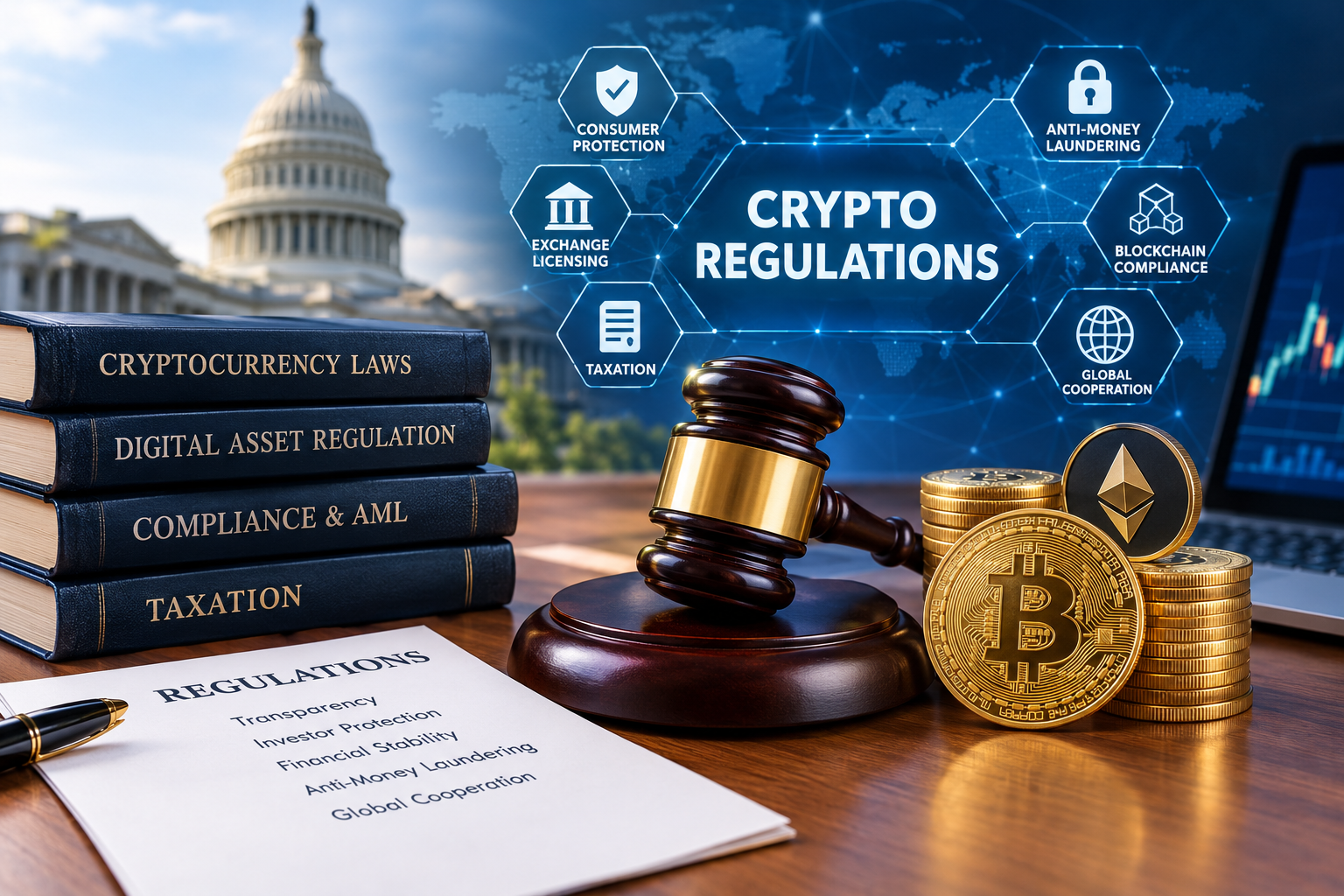
Crypto regulations refer to the legal requirements that Crypto Regulations govern the creation, distribution, exchange, transfer, storage, and taxation of digital assets. These rules determine which businesses can provide cryptocurrency services, what information they must disclose, and how they should protect customers and financial systems.
Unlike traditional financial products, cryptocurrencies can operate on decentralized networks without a central authority controlling every transaction. This structure offers flexibility and global accessibility, but it also makes enforcement, accountability, and consumer protection more complicated.
How Cryptocurrency Laws Work
Governments generally use existing financial laws, new digital asset legislation, or a combination of both to regulate cryptocurrency activities. Depending on the country, Bitcoin may be treated differently from a token representing company shares, a stablecoin designed to maintain a fixed value, or a token that grants access to a digital service.
For example, a cryptocurrency exchange may need authorization to provide trading services, maintain customer records, monitor suspicious transactions, and meet cybersecurity standards. A business issuing a token may face additional requirements if the token qualifies as a regulated investment product.
The legal classification of a digital asset is especially important because it determines which rules apply. The same cryptocurrency-related business model may face different requirements in different jurisdictions.
Why Crypto Regulations Matter
Crypto regulations matter because they influence trust, financial stability, and the long-term development of the cryptocurrency industry. Clear rules can help legitimate businesses understand their responsibilities while making it easier for investors to identify regulated service providers.
Regulations can also reduce opportunities for fraud, market manipulation, money laundering, and misleading investment promotions. However, poorly designed rules may increase compliance costs, discourage startups, or prevent ordinary users from accessing useful financial technologies.
The challenge is to establish a framework that protects consumers without eliminating the innovation that makes blockchain technology valuable.
Why Governments Are Regulating Cryptocurrency
Governments regulate cryptocurrency for several interconnected reasons, including investor protection, financial crime prevention, market integrity, taxation, and financial stability. Each objective addresses a different risk associated with digital asset markets.
Protecting Cryptocurrency Investors
Cryptocurrency prices can change dramatically within short periods, and many digital asset projects provide limited information about their operations, finances, or long-term prospects. Investors may also encounter fraudulent exchanges, fake investment platforms, misleading advertisements, and projects that disappear after collecting funds.
Investor protection laws can require regulated companies to disclose relevant information, maintain appropriate operational controls, and communicate risks honestly. These measures help users evaluate investment opportunities and understand the responsibilities of the businesses holding or managing their assets.
Nevertheless, regulation cannot eliminate investment risk. Even a legally compliant cryptocurrency can lose substantial value because of market conditions, technical failures, or declining demand.
Preventing Money Laundering and Financial Crime

Cryptocurrencies can move across borders quickly, sometimes without the traditional banking intermediaries involved in conventional transfers. Criminals may attempt to exploit these features to conceal the origins of funds or evade financial restrictions.
Authorities therefore focus on anti-money laundering (AML) and counter-terrorist financing (CFT) requirements. These may include customer identity verification, transaction monitoring, suspicious activity reporting, and recordkeeping.
The Financial Action Task Force, an international standard-setting body, provides guidance for regulating virtual asset service providers and strengthening financial crime controls. Its 2026 implementation update highlights continuing gaps in supervision, licensing, international cooperation, and the management of emerging risks involving stablecoins and decentralized finance.
Improving Market Transparency
Another major objective of crypto regulations is to reduce market manipulation and misleading business practices. Cryptocurrency markets can be affected by coordinated trading, false announcements, undisclosed conflicts of interest, and artificial trading volumes.
Market transparency requirements can encourage accurate disclosures and fairer trading practices. Regulators may also investigate insider dealing, fraudulent promotions, or attempts to manipulate token prices where applicable laws prohibit such conduct.
Greater transparency helps investors make decisions using reliable information rather than unsupported claims. It can also strengthen confidence among financial institutions considering cryptocurrency-related services.
Types of Cryptocurrency Regulations
Crypto regulations are not a single set of rules. They consist of several regulatory categories that apply to different activities, assets, and business models.
Exchange Licensing and Registration
Cryptocurrency exchanges allow users to buy, sell, and trade digital assets. Because these platforms may control customer funds and facilitate large volumes of transactions, regulators often impose registration, licensing, or authorization requirements.
Depending on the jurisdiction, exchanges may need to verify customers, maintain transaction records, protect client assets, implement cybersecurity controls, and report suspicious activity. Some jurisdictions also require information about company ownership, financial resources, and operational management.
A platform operating legally in one country may not automatically be authorized to serve customers everywhere. Users should therefore check whether an exchange is permitted to operate in their jurisdiction rather than assuming that an international website complies with local law.
Securities and Digital Asset Classification
One of the most complicated aspects of cryptocurrency regulation is deciding whether a digital asset falls under securities laws, commodity rules, payments legislation, or another legal framework.
A token that represents ownership or promises investment returns may receive different treatment from a token used primarily to access a blockchain application. However, labels alone do not determine legal status; the asset’s characteristics, distribution, associated promises, and surrounding transactions may all matter.
In the United States, the Securities and Exchange Commission issued an interpretation in March 2026 explaining how federal securities laws apply to various categories of crypto assets and certain transactions. The guidance discusses digital commodities, digital collectibles, digital tools, stablecoins, and digital securities, while also addressing activities such as staking, mining, wrapping, and airdrops.
This illustrates why businesses need to evaluate the specific legal characteristics of their products instead of treating every cryptocurrency as legally identical.
Stablecoin Regulations
Stablecoins are digital assets designed to maintain a relatively stable value against a reference asset, often a national currency. They are widely used for trading, blockchain payments, and transfers between cryptocurrency platforms.
Because stablecoins may function like payment instruments, regulators increasingly examine how they are issued, backed, redeemed, and managed. Depending on the applicable law, issuers may face requirements involving reserves, redemption rights, disclosures, governance, and financial reporting.
Stablecoin regulation is particularly important because confidence in a stablecoin depends on users believing that its value can be maintained and that redemption arrangements will work as promised.
A stablecoin’s name or stated objective does not guarantee safety. Users should examine its legal structure, reserve disclosures, redemption conditions, and the regulatory status of its issuer.
Taxation of Cryptocurrency
Cryptocurrency taxation determines how governments treat income, profits, payments, and other transactions involving digital assets. Tax treatment varies according to national law and the circumstances of each transaction.
In some jurisdictions, selling cryptocurrency at a profit may create a taxable capital gain. Receiving digital assets for employment, business services, mining, or other activities may be treated differently. Certain crypto-to-crypto trades may also have tax consequences even when no traditional currency is received.
Crypto tax compliance requires accurate records of acquisition prices, disposal values, transaction dates, fees, and relevant income. Keeping this information organized can make it easier to calculate potential tax liabilities and respond to reporting obligations.
Investors should not assume that cryptocurrency transactions are tax-free simply because they occur on a blockchain or through a self-custody wallet. Local tax rules and reporting requirements should always be checked.
Global Crypto Regulations: How Countries Differ
The global regulatory environment remains diverse. Some jurisdictions have developed comprehensive frameworks for digital asset businesses, while others rely on existing financial legislation or restrict particular cryptocurrency activities.
This variation affects where companies establish operations, which services they offer, and how international investors access digital assets.
Cryptocurrency Regulation in the United States
The United States uses a combination of federal and state laws to regulate different parts of the cryptocurrency industry. Securities, commodities, money transmission, taxation, consumer protection, and financial crime rules may all be relevant depending on the activity.
The SEC and Commodity Futures Trading Commission have important roles in their respective areas of authority. Other agencies may oversee banking relationships, money services, taxation, or financial crime compliance.
Regulatory developments in 2026 include efforts to clarify how securities laws apply to digital assets and proposals for tailored rules covering certain token offerings. For example, the SEC’s August 2026 Regulation Crypto Assets proposal outlines potential exemptions and disclosure requirements for specified investment-contract offerings. It is a proposal, not a blanket exemption from existing law.
For businesses, the practical lesson is that legal analysis must consider the product, the transaction, the service provider, and the customers being served.
Cryptocurrency Regulation in the European Union
The European Union has pursued a more harmonized approach through its Markets in Crypto-Assets Regulation, commonly known as MiCA. The framework establishes rules for covered crypto-asset issuers and service providers, including authorization and conduct requirements.
Its approach is intended to provide greater consistency across participating EU markets while supporting consumer protection and market integrity. Requirements can vary according to the type of crypto asset, the service provided, and applicable transitional or related legal provisions.
MiCA does not mean that every crypto-related activity is automatically permitted throughout the EU. Businesses must determine whether their products fall within its scope and whether other rules, such as financial services or anti-money laundering legislation, also apply.
Companies seeking to operate in European markets should review the relevant national competent authority’s guidance and the current legal requirements for their specific services.
Cryptocurrency Regulation in Asia
Asia contains a wide range of regulatory approaches, reflecting differences in financial systems, economic priorities, and attitudes toward digital assets.
Some jurisdictions have established licensing systems for exchanges and other virtual asset businesses. Others have developed rules for digital payment tokens, stablecoins, custody services, or institutional participation. Certain countries maintain stricter limitations on cryptocurrency trading or related financial services.
For investors, these differences mean that access to an exchange, payment product, or token may depend on their location. For businesses, operating across several Asian markets may require separate legal assessments, registrations, and compliance arrangements.
The broader trend is toward more detailed oversight, although the pace and scope of implementation remain different from one jurisdiction to another.
Cryptocurrency Regulation in Pakistan
Pakistan is an important market to watch because digital asset adoption, financial inclusion, and regulatory oversight are significant issues for its economy. People interested in cryptocurrency should distinguish between public discussion about policy changes and legal requirements that have actually taken effect.
The status of cryptocurrency-related activities can depend on current legislation, official notifications, licensing arrangements, and instructions from the relevant authorities. A policy announcement or proposed framework should not automatically be interpreted as full legal authorization for every exchange, token, or financial service.
Crypto regulations in Pakistan should therefore be assessed using current official sources, including the State Bank of Pakistan, the Securities and Exchange Commission of Pakistan, and any legally designated digital asset regulatory authority.
Investors and businesses should verify the latest requirements before depositing funds with a platform, launching a token, offering investment services, or accepting cryptocurrency for commercial purposes. Tax obligations and banking restrictions should also be assessed separately, since permission to conduct one type of activity does not necessarily authorize all related activities.
How Crypto Regulations Affect Investors and Businesses
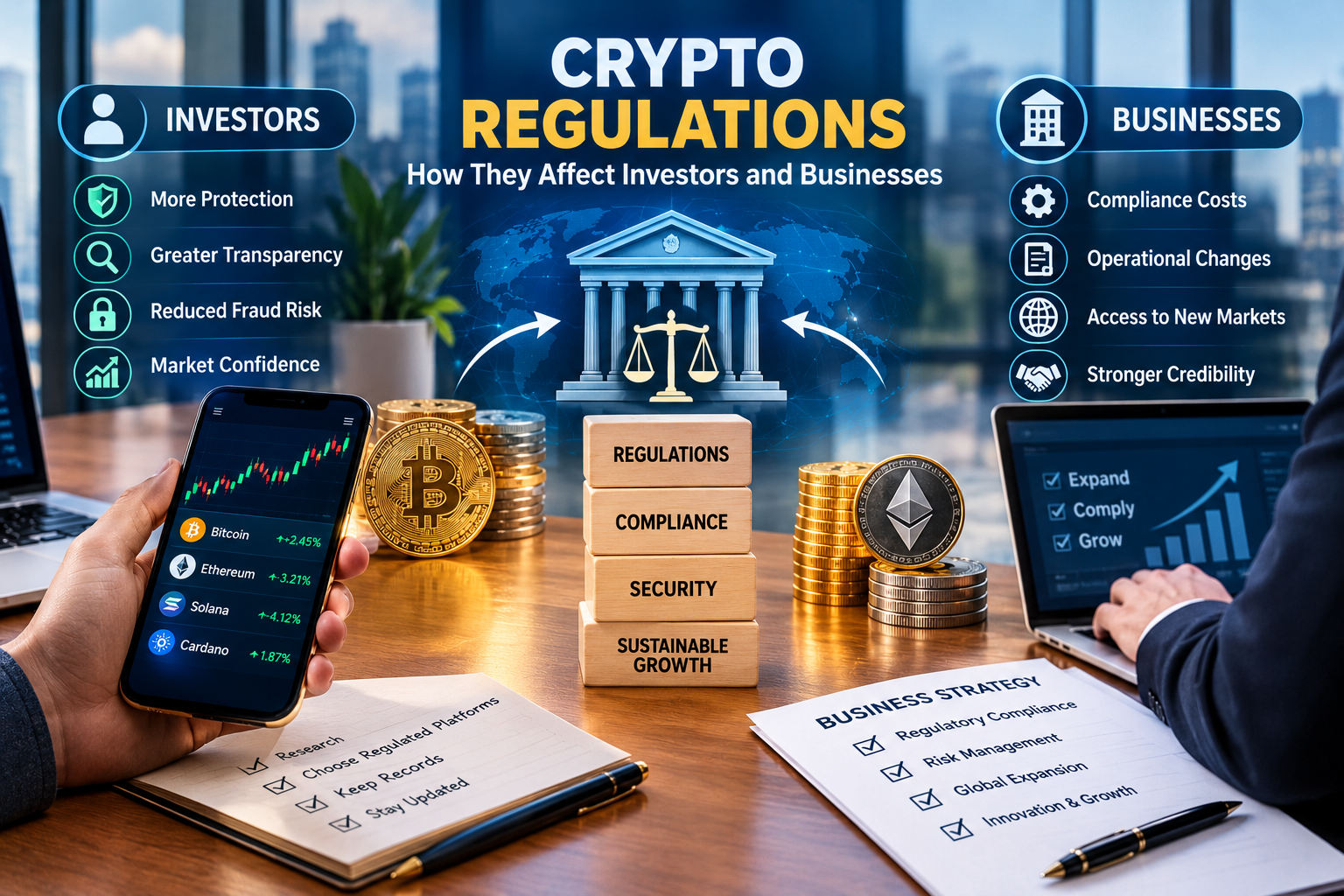
Cryptocurrency laws influence how individual investors manage digital assets and how companies develop products for the blockchain economy. Understanding these effects helps market participants prepare for changes and avoid preventable compliance problems.
Impact on Cryptocurrency Prices
Regulatory announcements can influence market sentiment because investors often respond to changes in the legal environment. News about exchange licensing, stablecoin legislation, taxation, or institutional access may affect expectations about future cryptocurrency adoption.
Clearer rules can improve confidence by reducing uncertainty for businesses and investors. For example, a well-defined framework may encourage financial institutions to explore compliant cryptocurrency services, potentially increasing participation in the market.
However, regulatory news does not always push prices upward. Restrictions, enforcement actions, unexpected compliance costs, or uncertainty about a proposed law can contribute to selling pressure and short-term volatility.
The relationship between crypto regulations and Bitcoin prices is therefore complex. Prices also depend on liquidity, monetary policy, investor demand, technological developments, and broader economic conditions. Investors should avoid treating any regulatory announcement as a guaranteed trading signal.
Compliance Costs for Cryptocurrency Businesses
Cryptocurrency companies may need legal advisers, compliance officers, transaction-monitoring systems, cybersecurity specialists, and procedures for verifying customer identities. These requirements can increase operating costs, particularly for startups with limited resources.
At the same time, effective compliance can help a business establish credibility with customers, banking partners, payment providers, and institutional investors. Companies that understand their obligations early may also find it easier to expand into additional markets.
The challenge is to build compliance into business operations without creating unnecessary barriers to innovation. Smaller companies can benefit from clearly defined licensing processes, proportionate requirements, and reliable regulatory guidance.
Effects on Decentralized Finance
Decentralized finance (DeFi) uses blockchain-based smart contracts to provide services such as lending, borrowing, trading, and liquidity provision. Some protocols operate without a traditional central intermediary, which complicates the application of conventional financial rules.
Regulators may examine identifiable operators, governance organizations, developers, interfaces, token issuers, or service providers depending on the facts and the applicable law. The existence of decentralized software does not automatically mean that every person or organization involved is exempt from legal obligations.
The Financial Action Task Force has identified continuing challenges related to decentralized finance, unhosted wallets, and offshore virtual asset service providers. These concerns demonstrate the difficulty of applying financial crime controls to systems that operate across borders and may lack a single responsible intermediary.
Future DeFi regulation will need to address genuine risks while considering the technical differences between decentralized protocols and conventional financial institutions.
Major Challenges in Crypto Regulation
Although regulation can improve accountability, creating effective cryptocurrency laws is not straightforward. Digital assets evolve quickly, operate internationally, and can combine several financial functions within one product.
Balancing Innovation and Consumer Protection
One of the biggest challenges is protecting consumers without preventing useful technology from developing. Excessively restrictive policies may discourage entrepreneurs, limit competition, and push some activities toward less transparent markets.
On the other hand, weak oversight can leave consumers exposed to fraud, inadequate disclosures, poor custody practices, and irresponsible business operations.
An effective regulatory framework should be proportionate to the risks involved. Payment services, investment products, stablecoins, and decentralized applications may require different safeguards because they perform different functions.
Cross-Border Enforcement
Blockchain transactions can move between countries within minutes, while legal authority is usually tied to specific jurisdictions. A company may be incorporated in one country, operate its servers elsewhere, and serve customers around the world.
This creates difficulties when regulators need information, investigate fraud, recover assets, or coordinate enforcement actions. Differences in definitions and reporting standards can make cooperation even more complicated.
International regulatory cooperation is therefore essential. Shared standards, information exchange, and compatible compliance expectations can help authorities address cross-border risks without requiring every country to adopt identical legislation.
Privacy and Financial Surveillance
Regulatory compliance can involve collecting identity documents, transaction histories, and other personal information. These controls can help identify suspicious activity, but they also raise concerns about data security, privacy, and the misuse of personal information.
Cryptocurrency businesses need appropriate safeguards for storing and processing customer data. Regulators must also consider how to balance legitimate financial crime investigations with privacy rights and applicable data protection laws.
This balance is particularly important for blockchain systems because transaction records may remain publicly accessible long after a transaction occurs.
The Future of Crypto Regulations in 2026 and Beyond
The future of cryptocurrency regulation will likely involve more detailed rules, improved international coordination, and closer attention to stablecoins, custody, tokenized financial products, and decentralized services.
The precise direction will depend on legislative decisions, regulatory consultations, market developments, and how effectively existing frameworks address emerging risks.
Greater Regulatory Clarity
Businesses and investors need to understand which rules apply to specific assets and activities. Regulators are increasingly examining how digital assets should be classified and how established financial laws can apply to blockchain-based products.
In the United States, the SEC and CFTC issued coordinated guidance in March 2026 concerning the treatment of various crypto assets and transactions under federal securities laws. Further regulatory proposals demonstrate that the framework continues to develop rather than remaining fixed.
Greater clarity may help legitimate projects plan their operations and communicate with investors more accurately. Nevertheless, new guidance may introduce additional questions, and proposed rules should not be confused with finalized legal requirements.
Institutional Adoption and Digital Asset Services
Banks, asset managers, payment companies, and other financial institutions may be more willing to explore cryptocurrency services when legal responsibilities and operational risks are clearly defined.
Potential developments include regulated custody, tokenized financial instruments, blockchain-based settlement, and payment services involving eligible digital assets.
These opportunities also create new compliance responsibilities. Institutions may need to evaluate custody arrangements, customer disclosures, technology risks, liquidity, and the legal status of the assets they support.
A clear regulatory environment can facilitate responsible participation, but it does not eliminate market volatility or guarantee the success of cryptocurrency products.
Stronger Stablecoin Oversight
Stablecoins are likely to remain an important focus of financial regulators because they connect blockchain networks with conventional currencies and payment systems.
Authorities may place greater emphasis on reserve quality, redemption rights, governance, operational resilience, and transparent disclosures. These measures aim to improve confidence that a stablecoin can perform its intended function during normal conditions and periods of market stress.
The international policy discussion also reflects concerns about the increasing integration of stablecoins into financial systems. The Bank for International Settlements’ Financial Stability Institute published a 2026 summary examining implementation of the global regulatory framework for crypto assets and stablecoins.
For users, this means that evaluating a stablecoin should involve more than checking its advertised price. Its backing, legal structure, redemption mechanisms, and issuer responsibilities also matter.
How Investors Can Stay Compliant With Crypto Regulations
Investors can reduce avoidable legal and financial risks by understanding the rules that apply to their location and activities. Compliance is not limited to cryptocurrency companies; individuals may also have tax reporting responsibilities or restrictions on particular transactions.
Choose Platforms Carefully
Before opening an account, users should investigate an exchange’s regulatory status, security practices, custody arrangements, and withdrawal conditions. A platform’s marketing claims or international presence do not prove that it is authorized to operate in a particular country.
Investors should also understand whether they retain control of their assets or rely on a third party to hold them. Exchange insolvency, account restrictions, and security incidents can create risks even when a platform has complied with certain legal requirements.
Maintain Accurate Transaction Records
Keeping complete transaction records can help investors calculate gains, document income, and respond to applicable reporting requirements. Useful information may include purchase dates, acquisition costs, disposal values, transaction fees, wallet transfers, and records of relevant income.
The precise documentation required depends on local law and the type of activity. Investors with complex holdings or substantial transactions may benefit from consulting a qualified tax professional.
Follow Official Regulatory Updates
Cryptocurrency legislation and regulatory guidance can change over time. Investors should consult official government publications and regulators rather than relying exclusively on social media posts, influencer commentary, or outdated articles.
Businesses should take additional care when expanding into new markets, launching tokens, or introducing financial products. Professional legal advice can help clarify licensing obligations, disclosure requirements, and the treatment of new business models.
Conclusion
Crypto regulations are becoming an increasingly important part of the global digital asset industry. They influence how cryptocurrency exchanges operate, how investors are protected, how digital assets are taxed, and how businesses develop blockchain-based financial services.
Although regulatory approaches differ across countries, many authorities share common objectives: reducing financial crime, improving transparency, protecting consumers, and supporting the integrity of financial markets. International coordination is also becoming more important as stablecoins, decentralized finance, and cross-border transactions continue to develop.
For investors, understanding cryptocurrency laws, digital asset compliance, and local reporting requirements can help reduce avoidable risks. For businesses, a clear compliance strategy can support responsible growth and build trust with customers and financial partners.
The future of crypto regulations will depend on whether governments can balance innovation with accountability. Clear, proportionate, and adaptable rules could help legitimate cryptocurrency projects grow while providing stronger protections for users. However, regulations cannot eliminate investment losses, technical vulnerabilities, or every form of financial crime.
As the industry evolves, staying informed through official regulatory sources and seeking qualified professional advice when necessary will remain essential for navigating the cryptocurrency market responsibly.
Frequently Asked Questions About Crypto Regulations
What are crypto regulations?
Crypto regulations are laws and regulatory requirements governing digital assets, cryptocurrency exchanges, token issuers, trading services, taxation, and related financial activities. Their scope varies by jurisdiction and by the type of asset or service involved.
Why are cryptocurrency regulations important?
Cryptocurrency regulations can help protect investors, discourage financial crime, improve market transparency, and establish clearer responsibilities for businesses. Their effectiveness depends on how well the rules are designed, implemented, and enforced.
Are cryptocurrency regulations the same in every country?
No. Countries use different legal frameworks, licensing systems, tax rules, and restrictions. A cryptocurrency service permitted in one jurisdiction may face additional requirements or limitations in another.
How do crypto regulations affect Bitcoin?
Regulatory changes can influence investor confidence, exchange access, institutional participation, and market sentiment. Their effects on Bitcoin’s price are uncertain because prices also depend on demand, liquidity, economic conditions, and other factors.
What is the future of crypto regulations?
The future is likely to involve continued development of Crypto Regulations rules for stablecoins, digital asset custody, exchanges, decentralized finance, and tokenized financial products. The exact requirements will depend on legislation and regulatory decisions in individual jurisdictions.